
Brighton & Hove has been named the UK’s most creative city, beating London and Edinburgh as regional hubs power Britain’s creative economy.
Key Findings:
• Brighton was crowned the ultimate creative city, achieving a perfect score of 10/10.
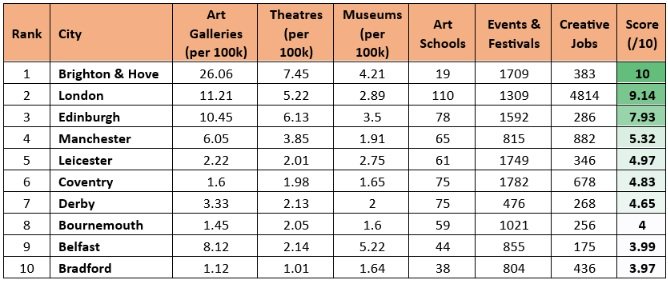
• The city has the highest number of events (1,709), theatres (7.45), and art galleries (26) per 100,000 residents.
• Despite its strong artistic culture, Brighton has one of the lowest numbers of art schools overall, with just 19.
• Brighton outshone the capital, beating London’s 9.14/10 score to secure the top ranking
Brighton & Hove has been crowned the UK’s most creative city, topping a new national index that reveals how smaller, well-connected urban hubs are increasingly outpacing major metropolitan centres when it comes to cultural energy, collaboration and innovation.
The research, conducted by Co-space, analysed galleries, theatres, museums, art schools, festivals and creative jobs across major cities to produce an overall Creative City Index score.
Brighton & Hove ranked first with a perfect 10, followed by London in second (9.14) and Edinburgh in third (7.93). Manchester and Leicester completed the top five.
Brighton & Hove has been crowned the UK’s most creative city, outscoring London and every other major cultural hub thanks to its exceptional density of galleries, theatres and museums, according to new rankings.
The south coast city topped the table with a perfect 10/10 score, boasting 26 art galleries per 100,000 people, more than double London’s rate, alongside the highest concentration of theatres and one of the strongest museum provisions nationwide.
Despite its relatively small size, it also hosts more than 1,700 events and festivals, underlining its year-round cultural buzz. This combination of venues, audiences and independent makers has helped foster what experts describe as a “self-sustaining creative cluster,” where proximity and collaboration drive constant new ideas.
London placed second overall but remains the country’s undisputed heavyweight by scale. The capital accounts for 4,800+ creative jobs and 110 art schools, dwarfing every other city on both measures and reinforcing its status as the UK’s primary creative engine.
However, the rankings suggest that sheer size no longer guarantees the top spot with an outstanding score of 9.14 out of 10, as smaller cities compete on accessibility, density and community.
Edinburgh ranked third with a solid 7.93 out of 10, driven by its globally recognised festivals and strong per-capita cultural infrastructure, it hosts over six theatres and three museums per 100,000 residents, some of the highest outside the capital.
The city’s blend of heritage, tourism and creative talent continues to make it a magnet for performers, producers and cultural entrepreneurs.
Manchester secured fourth (5.32), reflecting its fast-growing creative workforce and established strengths in music, media and digital industries. Leicester emerged as one of the surprise performers in fifth place (4.97), hosting 1,749 events and festivals, more than London or Edinburgh, despite a much smaller population.
The findings point to a shift in where creativity thrives. Rather than being concentrated in one dominant metropolis, creative activity is increasingly spread across regional clusters, where venues, education, jobs and communities exist side by side.
Industry experts say these dense ecosystems make collaboration easier and costs lower, helping freelancers, start-ups and cultural organisations flourish outside London, and reshape the UK’s creative map in the process.
“When creative people and spaces are concentrated together, ideas travel quickly,” said William Stokes, CEO of hybrid working hub, Co-space. “It’s not just about the number of venues or jobs but how connected they are. Cities that are walkable, affordable and community-driven are increasingly attractive to independent creatives and small businesses.”
Across the top-ranked cities, flexible workspaces are helping freelancers, start-ups and small agencies collaborate under one roof, lowering barriers to entry and turning local networks into thriving innovation communities.
These spaces are increasingly acting as anchors for local creative clusters, helping talent stay local rather than relocating to London.