Professor Robin Banerjee
A new study on how people spend their leisure time has revealed that scrolling social media is the activity that brings us the least joy – despite being the activity that people do most frequently.
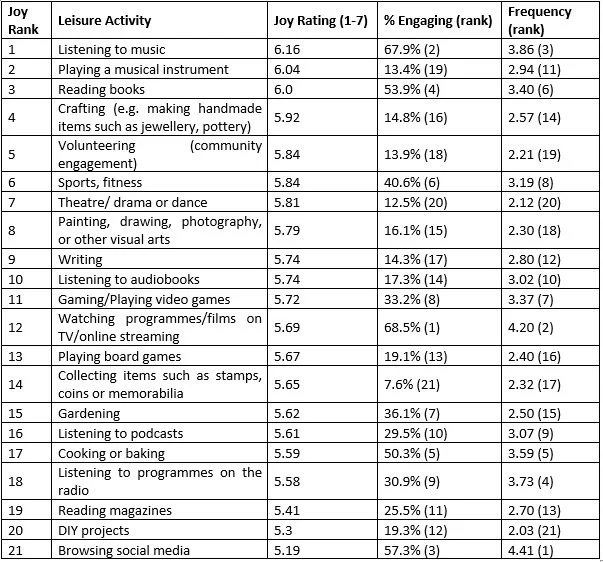
In the study carried out by the University of Sussex, from a list of 21 popular leisure pursuits, scrolling on social media was one of the top three activities that people chose to do during their free time, and was the single most frequently engaged with activity.
However, it was rated the lowest out of all 21 activities for how much joy it brought into their lives, illustrating a disconnect between how we choose to spend our leisure time and what truly supports our wellbeing.
The nationally representative survey of 2,182 respondents commissioned by Immediate, home to trusted brands people love, including Radio Times and Good Food, was conducted by psychologists from the University of Sussex to explore the emotional impact of people’s leisure activities to try to understand what brings us joy.
Listening to music for pleasure topped the list, receiving an average joy score of 6.16 out of 7 (rated from 1=not at all to 7= extremely).
Second in terms of the joy rating was playing a musical instrument (6.04), with reading books third (6.00), followed by crafting and volunteering in community engagement. These were not necessarily activities that people engaged with very frequently during the week, but it was clear that they brought a high level of satisfaction (see the full results below).
Overall, media consumption tended to score lower for joy than more active pursuits. Watching TV was the most popular leisure activity in terms of the number of people chose to do it and scored much higher for joy than browsing social media (ranked 12th in comparison to 21st out of the 21 activities).
Professor Robin Banerjee, Professor of Developmental Psychology at the University of Sussex, who led the research, says: “The study provides compelling evidence that an important key to psychological fulfilment and wellbeing could lie in being more intentional with our leisure time. These findings highlight the importance of dedicating time to hobbies that are emotionally rewarding and socially enriching, offering a powerful blueprint for maximising personal wellbeing. It is also striking to see the activity we do with the most frequency, social media scrolling, is the activity that brings us least joy, suggesting that if we are led by what intrinsically motivates us as opposed to algorithms we can move towards experiencing more joy in our lives.”
In another major part of the project, using both quantitative survey data and in-depth analysis of focus groups, the researchers explored in more detail the psychological processes involved in some of the leisure pursuits, including TV and radio, cooking and baking, and gardening.
The results showed talking with others about their interests was associated with lower mental health difficulties, as well as greater wellbeing and more generalised trust in others. The research also showed strong links between joy, intrinsic motivation, immersion, and being in a state of ‘flow’ during the activity.